BodyEase, Twickenham
TW2 5UL. My own clinic, and the widest choice of appointment times. Book directly with me.
I assess, treat, and explain what I have found and why, all in the first session. Where the picture is not clear-cut, I will tell you that too, and what we do about it.
Mihai Apostol, BSc (Hons) Osteopathy, BCOM London. Registered with the General Osteopathic Council, No. 21866. Years in MSK practice, including two years of first-contact assessment.
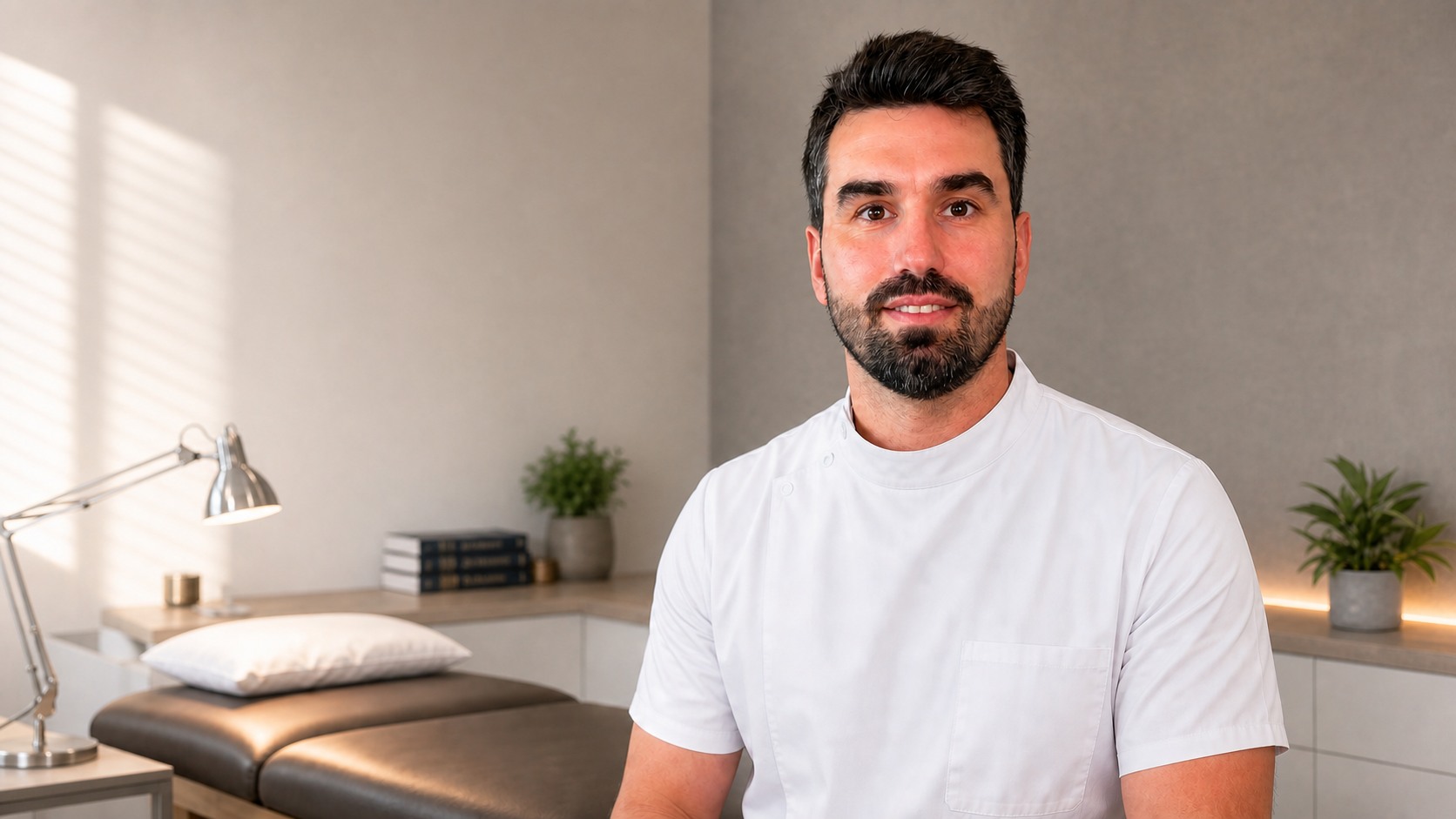

Osteopathy is four to five years of degree-level training in musculoskeletal assessment and hands-on treatment. “Osteopath” is a title protected by law: only practitioners registered with the General Osteopathic Council may use it, and keeping that registration requires continuing professional development every year.
It sits inside the allied health professions recognised by NHS England — the same group as physiotherapy, dietetics and paramedicine — and has done since 2017.
In practice that means the first thing I do is work out what is actually driving your symptoms, including whether it is something I should be treating at all. The hands-on work follows the assessment. It does not replace it.
Monday to Saturday, 09:00 to 19:00. Your first appointment is 60 minutes: a full assessment, hands-on treatment, and a plan you understand before you leave.
TW2 5UL. My own clinic, and the widest choice of appointment times. Book directly with me.
I also practise at The Lensbury. Appointments there are booked through the club's own system. See what is available there.
I also practise at Body First UK in Hampton Hill. Appointments there are booked through that clinic directly.
For the Twickenham clinic, message me directly.
Book on WhatsApp32 conditions across all major joints and regions. If yours isn't listed, message and ask, with onward referral if anything falls outside the scope of manual therapy.
What I use is decided by the assessment, not chosen in advance. Most sessions combine several of these, and I explain what I am doing and why as I go.
Sustained pressure, friction and myofascial release to reduce tension, improve tissue quality, and prepare an area for joint work.
Graded, rhythmic movement to restore range and reduce stiffness. No sudden force, and calibrated to what you can tolerate.
Fine needles into myofascial trigger points to release muscle tension and reduce referred pain. Integrated into a session where the examination shows it will help.
A short, controlled thrust at a joint's end range. Always preceded by full assessment, and explained before it is used.
Movements that mobilise nerves where they are sensitised or restricted, when pain or tingling has a nerve component.
Progressive loading to rebuild strength, control and endurance, matched to your stage and capacity rather than a generic sheet.
Some problems need a GP, a consultant, imaging, or a different kind of therapist. If the assessment points that way, I'll say so and tell you who to see, rather than book you a course of treatment. That is what the 60 minutes is for: working out what is actually going on before anyone commits to anything.
All prices include assessment, treatment, and a clear plan. Initial assessment and treatment: £80, 60 minutes. Follow-up: £68, 30 to 45 minutes. Course of five sessions: £315.
£80
60 minutesA thorough assessment to find exactly what is driving your symptoms, followed by first hands-on treatment. You leave knowing the cause and the plan.
Start here£68
30 to 45 minutesProgress reviewed and the approach adjusted at every session. No template treatments. Each follow-up builds on what the previous one showed.
£315
1 initial + 4 follow-ups · £63/sessionA full course at a lower per-session rate. Whether a course suits your case is agreed at the first session, not assumed.
Cash, bank transfer, or card accepted.
Book on WhatsAppFour steps, from first message to a working plan.
Message on WhatsApp or use the contact form. I usually reply within a few hours, the same day, with available times. Once a time is agreed, you complete the new patient form at home so the full hour goes on assessment, not paperwork.
Your first session begins with a focused case history and physical examination, including orthopaedic and neurological screening where relevant.
Treatment follows directly from what the assessment shows: soft tissue work, joint mobilisation, neurodynamic mobilisation, and targeted movement advice, all tailored to you, not a standard protocol.
You leave knowing what is going on and what to do next. Follow-up sessions review progress and adjust the approach as you improve.
Osteopathy is a regulated healthcare profession concerned with how the body moves: pain, stiffness, restricted movement, and recurring strains. Assessment comes first — case history, movement testing, and orthopaedic or neurological screening where relevant — then hands-on treatment matched to what the examination actually shows. Techniques include soft tissue work, joint mobilisation and articulation, neurodynamics, progressive loading, and dry needling where the examination points to it, alongside movement advice and pain education.
“Osteopath” is a title protected by law in the UK. Only practitioners registered with the General Osteopathic Council may use it. My registration number is 21866, and it can be checked on the public General Osteopathic Council register.
Yes. Osteopathy is one of the allied health professions recognised by NHS England — the same group as physiotherapy, dietetics, paramedicine and radiography — which it joined in 2017. It is regulated by statute under the Osteopaths Act 1993.
Osteopaths also work as first contact practitioners: trained to be the first clinician a patient sees, to assess a problem that hasn't been diagnosed yet, screen for anything needing urgent or different care, and decide what should happen next. That is what the first hour here is for. I spent two years in first-contact practice before moving to private clinic work.
The approaches osteopaths use — manual therapy combined with exercise and advice — have a substantial evidence base for musculoskeletal pain. NICE recommends manual therapy alongside exercise for persistent low back pain, and similar approaches are widely used for neck pain, shoulder problems, hip and knee osteoarthritis, cervicogenic headache, and tendinopathies.
The evidence is stronger for some presentations than others. I'll tell you where yours sits rather than overstate it. Research indicates these approaches work largely through neurological mechanisms — reducing pain sensitivity and restoring confident movement — rather than by correcting structure, which is why they can help even when imaging shows little change.
Manual therapy is the hands-on part of what I do — the techniques themselves. Osteopathy is the profession and the training behind choosing which technique to use, when to use it, and when not to treat at all. In practice you'll experience manual therapy; the osteopathic training is what decides the plan.
Your first session lasts 60 minutes. It begins with a focused case history covering your symptoms, daily activities, and medical background. A physical assessment follows, including movement tests and, where relevant, orthopaedic and neurological screening. Hands-on treatment is then tailored to what the assessment shows. You leave with a clear plan and any exercises or self-care suggestions.
Loose, comfortable clothing that allows easy movement is ideal. Shorts and a t-shirt or vest top work well. Depending on the area being assessed, you may be asked to remove some clothing for accurate examination. Privacy and comfort are always respected, and a towel or gown is available if preferred.
Hands-on treatment can be uncomfortable at times, particularly with sensitive or long-standing conditions, but it is always within a level you find acceptable. You are in control throughout: I explain what I am doing, check in as I go, and adjust the approach based on your feedback.
It depends on how long the problem has been there and how your body responds. At the end of your first session I'll give you an estimate for your case.
Please give 24 hours notice to cancel or reschedule and there is no charge. For cancellations with less than 24 hours notice the full session fee applies.
Start with a clear assessment and a practical plan for your next step. Message on WhatsApp, call, or email; I reply within a few hours on clinic days.